What Is the Best AI Accounting and Audit Assistant?
2026-08-27
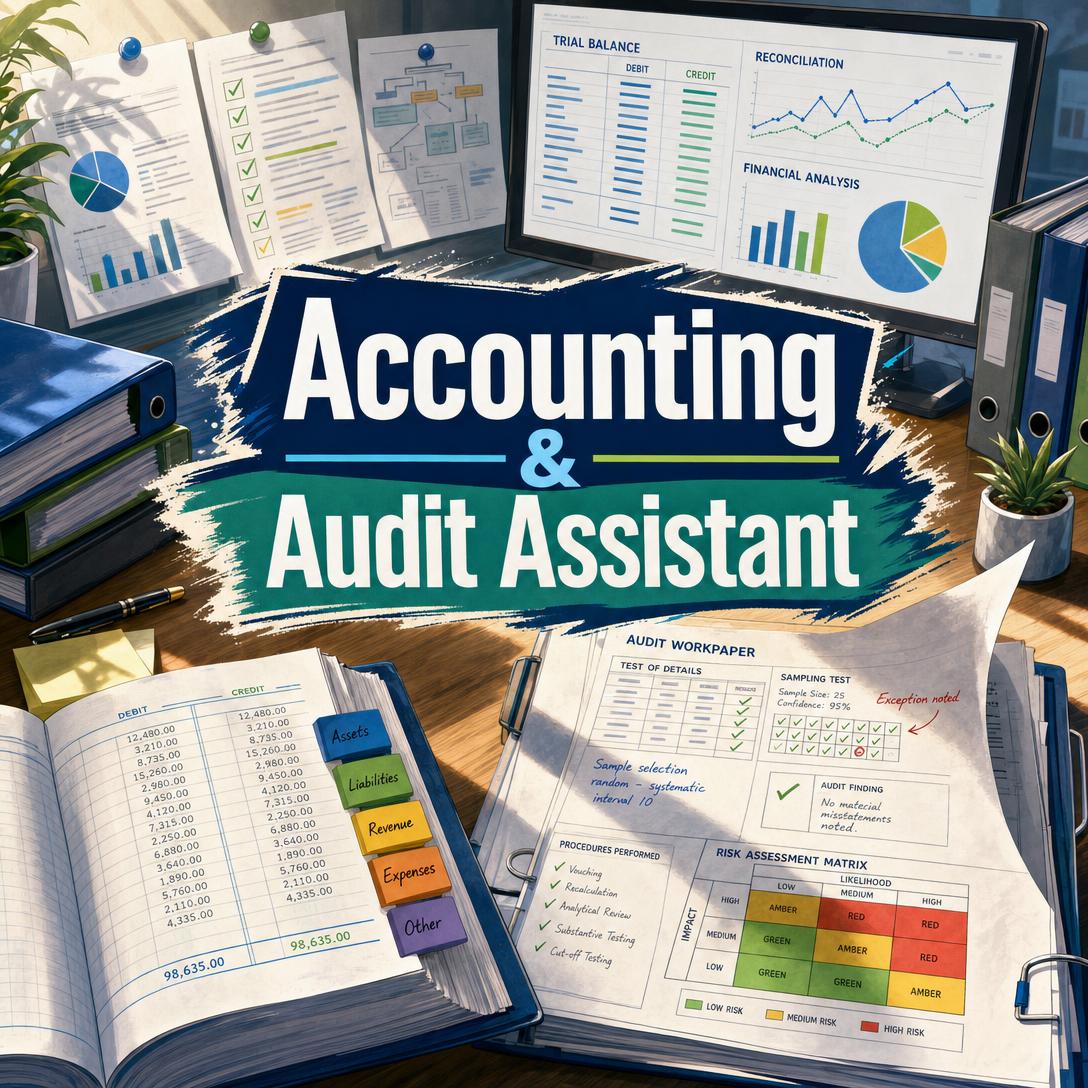
How Do AI Accounting Assistants Compare on Standards Guidance, Close Work, and Audit Planning?
The most useful way to rank AI accounting assistants in 2026 is by three jobs, not by a single “best tool” label: interpreting US GAAP and IFRS, turning transactions into reviewable entries, and designing audit procedures. Accounting & Audit Assistant is strongest when the work is judgment-heavy — named-standard walkthroughs, risk assessment, sampling design, and draft journal entries a reviewer can challenge. QuickBooks with Intuit Intelligence is stronger when the books need to live in a ledger with bank feeds and automated categorization. DataSnipper is stronger when audit evidence must be snipped, matched, and signed off inside Excel. Trullion is stronger for lease and revenue portfolios that need source-linked, audit-ready schedules.
Key factors that separate an effective AI accounting assistant from a generic chatbot or a bookkeeping app:
✅ Named-standard interpretation — ASC, IFRS, PCAOB, and ISA citations with jurisdiction confirmed, not generic “revenue should be recognized when earned” advice ✅ Reviewable processing — categorized expenses and journal entries in tables a controller can export, with anomalies flagged without being asked ✅ Audit procedure design — materiality, assertions, sampling, and findings in Condition/Criteria/Cause/Effect form, not just a document matcher ✅ System-of-record honesty — a clear line between advisory output and the general ledger that actually holds the books ✅ Evidence the reviewer can test — calculations shown, treatments labeled as standard vs. practice, and numbers the user is told to verify
To compare these products fairly, it helps to score them on a Standards-to-Workflow Fit model: interpretive depth, processing throughput, audit procedure design, system of record, evidence traceability, and total cost of access.
Why Are Finance Teams Adopting AI for Accounting and Audit Work in 2026?
Finance teams are adopting AI because close calendars, documentation load, and talent shortages have outpaced spreadsheet-only workflows, while daily AI use among accountants has already crossed into the mainstream. 46% of accountants now use AI tools daily, up from 18% in 2023. Exploration is still far ahead of production use: 63% of finance teams are exploring AI tools, but only 16% have implemented AI in day-to-day accounting workflows.
The commercial signal matches the workflow pressure. The AI-in-accounting market is estimated at USD 10.87 billion in 2026, up from USD 7.52 billion in 2025. A separate audit-analytics market was valued at USD 2.9 billion in 2025 and is projected to reach USD 20.1 billion by 2035. KPMG-reported figures cited in industry roundups put nearly 72% of businesses already piloting or using AI in financial reporting.
Time reallocation is the practical payoff. A study cited by Intuit found accountants using AI reallocated about 8.5% of their time away from routine data entry and cut 7.5 days off the monthly close. Gartner found 39% of finance functions already use AI specifically for anomaly and error detection. Greater adoption has also been associated with an 18% increase in weekly client support as routine work moves off the calendar.
The remaining gap is judgment. Worker access to AI rose by 50% in 2025, yet McKinsey’s CFO Pulse found 70% of CFOs cited already demanding workloads as the main reason automation efforts stall. Teams do not need another inbox. They need an assistant that can classify a batch, name the standard, and leave a file a reviewer can defend.
What Should You Look for in an AI Accounting and Audit Assistant?
You should score an AI accounting assistant on six dimensions: interpretive depth, processing throughput, audit procedure design, system of record, evidence traceability, and cost of access. Feature lists that stop at “automation” hide the difference between a ledger, an Excel add-in, a lease engine, and a senior-level advisor.
1. Interpretive depth. Confirm whether the product cites US GAAP (ASC Codification), IFRS, PCAOB auditing standards, ISA, IIA Standards, and COSO — and whether it asks jurisdiction, currency, and fiscal year-end before assuming USD and US GAAP. A useful assistant distinguishes authoritative guidance from common practice.
2. Processing throughput. Categorization, journal-entry drafts, ratio analysis, and close checklists should come back as tables with debits, credits, narratives, and subtotals. 27% of accountants and bookkeepers already treat keeping pace with tech as “survival-critical”, so batch speed matters, but only if a reviewer can see the mapping.
3. Audit procedure design. Look for risk assessment, materiality, assertion mapping, sampling design, analytical procedures, and deficiency classification. Document matching is not the same as planning an engagement.
4. System of record. Ask what holds the books. Bank feeds, AP invoices, and multi-entity consolidations belong in accounting software. Advisory output belongs in a review file. Mixing those jobs is how teams create untraceable entries.
5. Evidence traceability. EY’s global corporate reporting survey found 96% of finance leaders have concerns about data integrity, with 39% reporting format issues and 35% flagging inconsistencies. If the assistant cannot show source logic, it is a draft generator, not audit support.
6. Cost of access. Seat-based ERPs, custom audit platforms, and usage-based assistants price different failure modes. Cheap software that cannot interpret ASC 842 still burns partner time. An inexpensive assistant that cannot post to the GL still leaves the books in another system.
Intuit’s buyer guidance is consistent with this frame: start from use case, current workflow, pricing model, integration, security, and time-to-productivity — not from a generic AI label.
How Do Jenova, QuickBooks, DataSnipper, and Trullion Compare for Accounting Teams?
Jenova’s Accounting & Audit Assistant, QuickBooks with Intuit Intelligence, DataSnipper, and Trullion cover overlapping finance work but optimize for different systems of record. As of 2026, QuickBooks is the ledger-centric option for small businesses, DataSnipper is the Excel-native audit workpaper layer, Trullion is the lease-and-revenue compliance engine, and Jenova is the conversational senior-accountant layer for standards, entries, analysis, and audit planning.
| Feature / Dimension | QuickBooks with Intuit Intelligence | Jenova Accounting & Audit Assistant | DataSnipper | Trullion |
|---|---|---|---|---|
| GAAP / IFRS interpretation | Limited; bookkeeping insights and categorization, not deep ASC/IFRS advisory | Strong for US GAAP, IFRS, ASC 606/IFRS 15, ASC 842/IFRS 16, ASC 740 concepts, and policy drafts | Weak as a standards engine; Excel evidence and matching | Strong embedded logic for ASC 842, ASC 606, IFRS, and internal policies |
| Transaction processing | Automated categorization, bank rec, invoicing, books cleanup | Batch expense mapping (~100–300 items), JE drafts, FX/intercompany entries, TB and FS review | Extraction and matching inside Excel, not a GL | Extracts contracts and schedules into accounting inputs |
| Audit planning and risk | Operational reporting, not engagement planning | Risk assessment, materiality, audit programs, sampling, SOX 404 documentation, findings drafts | Testing, ticking/tying, anomaly checks in-sheet | Audit-ready outputs and source-backed treatments |
| System of record | Yes — general ledger with bank feeds | No live GL; user provides data; no QuickBooks/Xero/SAP connector | Excel workpapers | Contract-to-schedule platform, not a full SMB ledger |
| Evidence / audit trail | Accounting records inside Intuit | Tables, shown calculations, named standards; user must verify arithmetic | Every snip linked to source documents in Excel | Full audit trail from output back to source data |
| Pricing (as of 2026) | $19 to $137.50/month | Free tier with limited usage; paid plans from $20/month | Not publicly listed | Custom pricing |
| Best for | SMBs and firms that need the books in one product | Controllers, staff, auditors, and owners who need judgment, drafts, and checklists | Audit teams living in Excel | Mid-market/enterprise lease, revenue, and audit-ready reporting |
QuickBooks with Intuit Intelligence
QuickBooks is strongest as the system that actually holds the books. Intuit Intelligence adds automated categorization, reconciliation support, error identification, cash-flow forecasting, and AI-powered chat on plans that run from $19 to $137.50 per month with up to 25 users.
It is limited as an audit planner and as a standards desk. It will not draft a PCAOB-style risk assessment, design statistical sampling, or walk a non-accountant through a five-step IFRS 15 analysis with disclosure language. Teams that need the GL and the advisor usually pair it with something else.
Xero sits in the same ledger class, with pricing from $25 to $90 per month, strong bank reconciliation, and no per-user license fees on many plans. It is a credible alternative for firms that want cloud bookkeeping rather than a senior-level accounting conversation.
Jenova Accounting & Audit Assistant
Jenova is strongest as the colleague who accelerates brute-force work and then stays for the judgment call. It maps expenses to a client chart of accounts, drafts standard, adjusting, correcting, multi-currency, and intercompany entries, and produces ratio, variance, trend, common-size, breakeven, and cash-flow analysis in tables.
On the audit side, it can draft planning memos, engagement-letter language, audit programs, sampling approaches, analytical procedures, management-letter points, and deficiency classifications. It is limited by design: it cannot connect to QuickBooks, Xero, or SAP; it is not a binding audit opinion; it should not prepare tax returns; and large dumps need to be batched. Arithmetic still requires human verification.
DataSnipper
DataSnipper is strongest for audit teams that already live in Excel. Industry reviews describe AI-driven extraction, document matching with full traceability, in-sheet reconciliation, and anomaly checks, which cuts ticking and tying time.
It is limited outside Excel. Compatibility with other platforms is thin, and loading can slow on large statements or heavy scan batches. Pricing is not publicly listed. It is a workpaper accelerator, not a controller who can interpret a new ASU or design a first-year audit program from a trial balance.
Trullion
Trullion is strongest where contracts become accounting. It extracts terms from PDFs and spreadsheets, applies models for ASC 842 and ASC 606, and keeps a traceable link from every output back to source data. That is the right architecture for large lease portfolios and recurring revenue arrangements.
It is less suited to a 200-line expense dump, a close checklist for a 12-person firm, or a conversation that jumps from CoA design to fraud-triangle brainstorming. Pricing is custom. Vic.ai occupies a similarly specialized lane for accounts payable invoice processing rather than general advisory.
How Well Can AI Interpret US GAAP, IFRS, and Audit Standards?
AI can interpret US GAAP, IFRS, and audit standards well when it confirms the framework first, cites numbered guidance, and separates the standard from practice — and poorly when it assumes US GAAP, invents an ASC topic, or treats ChatGPT-style prose as an audit file. General models are useful for memos and research, but they are designed to generate answers, not maintain a verifiable audit trail or enforce accounting logic.
Jenova’s Accounting & Audit Assistant is built around that distinction. It treats US GAAP (ASC Codification) and IFRS as primary frameworks, with working depth in revenue (ASC 606 / IFRS 15), leases (ASC 842 / IFRS 16), financial instruments, income taxes (ASC 740 / IAS 12), consolidation, fair value, and impairment. On the audit side it draws on PCAOB auditing standards, ISA, IIA Standards, COSO, and ISQM. The useful behavior is procedural: confirm jurisdiction and currency before defaulting to USD, and search for current ASUs, effective dates, tax rates, and FX rates instead of reciting stale thresholds.
That currency requirement is not cosmetic in 2026. FASB has issued 2026 Accounting Standards Updates, including environmental credits and environmental credit obligations (Topic 818). The IAASB is proposing revisions to core standards to enhance the risk-based audit framework and address technological advances. An assistant that cannot timestamp those changes will quietly mis-cite a standard.
The honest limit is authority. An AI assistant can draft policy language, disclosure outlines, and GAAP-versus-IFRS comparison tables. It cannot replace the FASB Codification, an IFRS Foundation text, or a signed technical memo. Staff who need exam-level drilling on the same standards often pair this work with a CPA Tutor. Owners who need the accounting treatment of a tax position explained — not a return prepared — often move that thread to a Personal Tax Advisor.
What Can AI Assistants Actually Do During Audit Planning and Fieldwork?
AI assistants can accelerate planning, testing design, and reporting drafts; they cannot issue a licensed audit opinion or replace source-document examination. The split that holds up in practice is: the assistant designs and documents, the auditor still concludes.
On planning, Jenova can help set overall and performance materiality, map risks to assertions, draft audit programs, and propose statistical or non-statistical sampling. It can structure internal-audit planning, SOX 404 documentation and test design, fraud-risk brainstorming using the fraud triangle, and compliance checklists. Fieldwork support includes analytical procedures, evidence-evaluation questions, and assertion mapping. Reporting support includes findings in Condition/Criteria/Cause/Effect form, management-letter drafts, opinion language for review, and deficiency classification.
That is a different job from DataSnipper’s, which links Excel amounts to source documents so reviewer sign-off is faster. Both can exist in one engagement: Jenova for the program and the finding write-up, DataSnipper for the tickmark file. MindBridge, in the same audit-analytics class, is built for risk detection and financial data analysis rather than conversational procedure design.
The regulatory backdrop is getting stricter, not looser. Amended PCAOB AS 2201 on integrated audits of internal control is effective December 15, 2026. Deloitte has projected GenAI-enabled fraud losses in the US could rise from $12.3 billion in 2023 to $40 billion by 2027, which raises the bar on anomaly detection and documentation. An assistant that flags duplicate invoices or round-dollar journal entries is useful. An assistant that pretends those flags are a completed audit is not.
Partial work should be labeled as partial. Bank recs from user-provided data can identify matches and breaks, but not pull live bank feeds. Inventory examples can demonstrate FIFO, LIFO, or weighted average on small sets, not run a full stocktake. Lease accounting can be done end-to-end on individual contracts; complex portfolios still need specialized software such as Trullion.
How Do You Get Reliable Output From an AI Accounting Assistant?
You get reliable output by giving the assistant a framework, a period, a chart of accounts, and a review rule — then verifying every material number. Most failures are underspecified prompts, not model choice.
For Jenova’s Accounting & Audit Assistant, a first session usually takes under two minutes:
- Open the agent at jenova.ai/a/accounting-audit-assistant.
- State the job, entity, jurisdiction, currency, and standards:
"US GAAP, USD, calendar year-end. I'm the controller at a 40-person SaaS company. Categorize these 180 operating expenses to our 4-digit CoA and flag prepaids, leases, and related-party payments."
- Review the table, confirm treatments you want frozen, and send the next batch or the related advisory question.
For audit planning, lead with assertions and materiality rather than “help me audit revenue”:
"Draft an audit program for SaaS revenue under ASC 606. Performance materiality $250,000. Map procedures to occurrence, completeness, and cutoff, and propose a sampling approach for contract modifications."
For QuickBooks with Intuit Intelligence, setup is product-first: choose a plan, connect bank feeds, and review automated categorization and reconciliation suggestions inside the ledger. The review step still belongs to a person. Intuit’s own distinction is useful here — automation repeats a task; AI applies reasoning to exceptions. If the tool cannot explain an exception, it is not ready to post.
Receipt-heavy teams often stage data before the accounting conversation. An Expense & Receipt Tracker can turn photos and statements into categorized, export-ready records, after which the Accounting & Audit Assistant maps them to the CoA, drafts entries, and flags control issues. Owners who need the accounting output translated into operating decisions often continue in Business Co-Pilot.
Reliability rules that hold across tools:
- Batch large files. Context limits make 1,000-line dumps error-prone; 100–300 item slices keep mappings reviewable.
- Supply the CoA. Without it, you get standard categories, not your accounts.
- Show the work. Journal entries should include Date, Account, Debit, Credit, and Narrative.
- Verify arithmetic. Language models can mis-add. Material balances need a second pass.
- Treat treatments as drafts until confirmed. Exploratory classification is not a policy.
What Do Accounting Practitioners Say About Using AI on the Close and the Audit?
Practitioners who get value from AI on the close and the audit treat it as a preparer and a challenge function, not as the signer. The pattern that holds is: machines draft, humans conclude, and the file has to show both.
"The bottleneck is rarely raw categorization speed. Most teams can already dump a CSV into software. The hours sit in the judgment layer on top of it — whether a cloud contract is ASC 350-40 implementation versus run-rate OpEx, whether a customer credit is contra-revenue under ASC 606, whether a lease even is a lease under ASC 842. Assistants that only extract text still leave that layer on the manager."
"Audit files fail for a different reason. Matching a PDF to an Excel row is necessary, but it is not a risk assessment. If the tool cannot name the assertion, propose a procedure, and write the finding in a form a partner will sign, it is pre-accounting. That is why we separate ledger products, Excel evidence products, and advisory assistants instead of forcing one platform to pretend it is all three."
"The other non-negotiable is saying what the assistant cannot do. No live ERP feed, no payroll engine, no signed opinion, no tax return. Teams that hide those limits create unreviewable work. Teams that put the limit in the first exchange get faster close files, because reviewers know exactly which numbers still need a calculator and which conclusions still need a CPA."
— Jenova Product Team, domain-agent design for finance and accounting workflows
That view lines up with the implementation evidence. Clean data is the constraint, not model branding, which is why format issues and inconsistencies dominate finance-leader concerns about integrity. An assistant that flags a duplicate invoice and a missing vendor is doing audit-relevant work. An assistant that fills the gap with a plausible number is doing the opposite.
When Is an AI Accounting Assistant a Better Fit Than Accounting Software?
An AI accounting assistant is a better fit than accounting software when the bottleneck is interpretation, drafting, or review — not when the bottleneck is posting, paying, or reconciling live accounts. Software owns the ledger. The assistant owns the memo, the checklist, the exception, and the standard.
Choose accounting software (QuickBooks, Xero, Sage Intacct, or a close platform such as Numeric) when you need bank feeds, AP/AR workflows, multi-entity consolidation, or a continuous general ledger. Intuit’s roundup is explicit that QuickBooks, Xero, FreshBooks, and Zoho Books are built around invoicing, reconciliation, and reporting inside a bookkeeping system. Choose Trullion when the workload is a lease portfolio or revenue contract set that must stay tied to source documents. Choose DataSnipper when the audit file is Excel and the pain is ticking and tying.
Choose Jenova’s Accounting & Audit Assistant when a staff accountant needs 200 expenses mapped tonight, a controller needs an ASC 606 walkthrough before disclosure drafting, or an auditor needs a first-pass program and sampling plan. It is also the better fit when the user is not an accountant — a founder who can upload a trial balance and needs ratios, close steps, and plain-language flags rather than another ERP module.
The cost structure follows the job. QuickBooks plans start near $19 a month and rise to $137.50. Xero runs about $25 to $90 a month. Specialized audit and lease platforms are typically quote-based. Jenova’s Accounting & Audit Assistant is available at jenova.ai/a/accounting-audit-assistant, with a free tier for limited usage and paid plans starting at $20/month for 30× that allowance. None of those prices buy a CPA attestation. They buy speed on the work that still has to be reviewed.
The durable split in 2026 is not “AI versus accountants.” It is which layer of the file the product is allowed to touch. Ledgers post. Evidence tools link. Assistants draft, classify, interpret, and plan. The teams that keep those layers distinct are the ones whose AI output survives a partner review.
References
- AdAI News — Accounting AI Statistics 2026, daily AI use among accountants
- Accounting Seed — The State of AI in Accounting (2026), exploration versus day-to-day implementation
- Mordor Intelligence — AI in Accounting market size, 2025–2026
- Market.us — AI-powered data analysis in audits market size and outlook
- Trullion — AI software for finance and accounting, KPMG reporting-adoption figures, DataSnipper and MindBridge capabilities, ChatGPT/Claude limits, McKinsey CFO Pulse, EY data-integrity survey, Deloitte GenAI fraud projections
- Intuit — Best AI accounting software and tools for 2026, QuickBooks and Xero pricing, MIT Sloan/Stanford close-time findings, Gartner anomaly-detection usage, survival-critical tech statistic
- Ledge — Stats on AI usage in accounting, client-support time shift
- Deloitte — The State of AI in the Enterprise, 2026 report on worker access to AI
- PCAOB — Auditing Standards for issuer audits
- FASB — Accounting Standards Updates issued in 2026, including Topic 818 environmental credits
- IAASB — Proposed revisions to core standards for risk-based audits and technological advances
- PCAOB — AS 2201 amendments effective December 15, 2026