1M Context Roleplay AI: Persistent Memory for Long Stories
2026-09-15
Roleplay Game Master helps you run long, character-true stories by pairing a large working context with memory that keeps people, places, and promises intact. In September 2026, a 1M context roleplay AI can hold a novel-scale prompt in one pass — yet most chats still drop mid-plot facts, flatten voice, and force recaps. This AI treats your world as living state, not a decaying transcript.
✅ Persistent recall of characters, relationships, and unresolved hooks ✅ Consistent NPC voice, inventory, and consequences across sessions ✅ Open-ended play — romance, horror, sandbox, or original settings ✅ Playable on web, iPhone, and Android without losing world state
Players searching for a 1M context roleplay AI usually want one outcome: a partner who still knows who you insulted twenty scenes ago. To understand why a million-token window is not enough on its own, it helps to look at context rot, attention, and what actually has to persist.
Quick Answer: What Is a 1M Context Roleplay AI?
Roleplay Game Master is a 1M context roleplay AI that runs immersive scenes with persistent memory so characters, world state, and plot stay consistent across every session. It is built for players who want novel-length continuity without pasting a campaign bible into every reply.
Key capabilities:
- Long-session play that retains names, locations, debts, and secrets
- Character-consistent partners who remember bargains, insults, and tone
- Open-ended scenarios — romance, horror, heist, slice-of-life, or original worlds
- Cross-session continuity so you can close the app and resume the same story
A 1M-token context window is working memory: the prompt, your messages, and the next reply, considered together. That capacity is useful. It is not the same thing as a world that remembers.
Why 1M Context Roleplay AI Still Forgets
A context window is short-term memory, not a save file. Provider docs now say the quiet part out loud: more tokens are not automatically better, and as the window fills, accuracy and recall degrade — a pattern called context rot.
On paper, one million tokens sounds like enough story for a campaign.
Context rot — Performance drops as LLMs process increasingly long input contexts
That drop is not a rare edge case. Chroma’s long-context study held task difficulty constant and varied only input length across 18 models. Even simple retrieval and copy tasks got worse as the prompt grew. Needle-in-a-haystack scores had made million-token windows look solved. Realistic work — finding the right beat in a noisy history, then reasoning over it — did not.
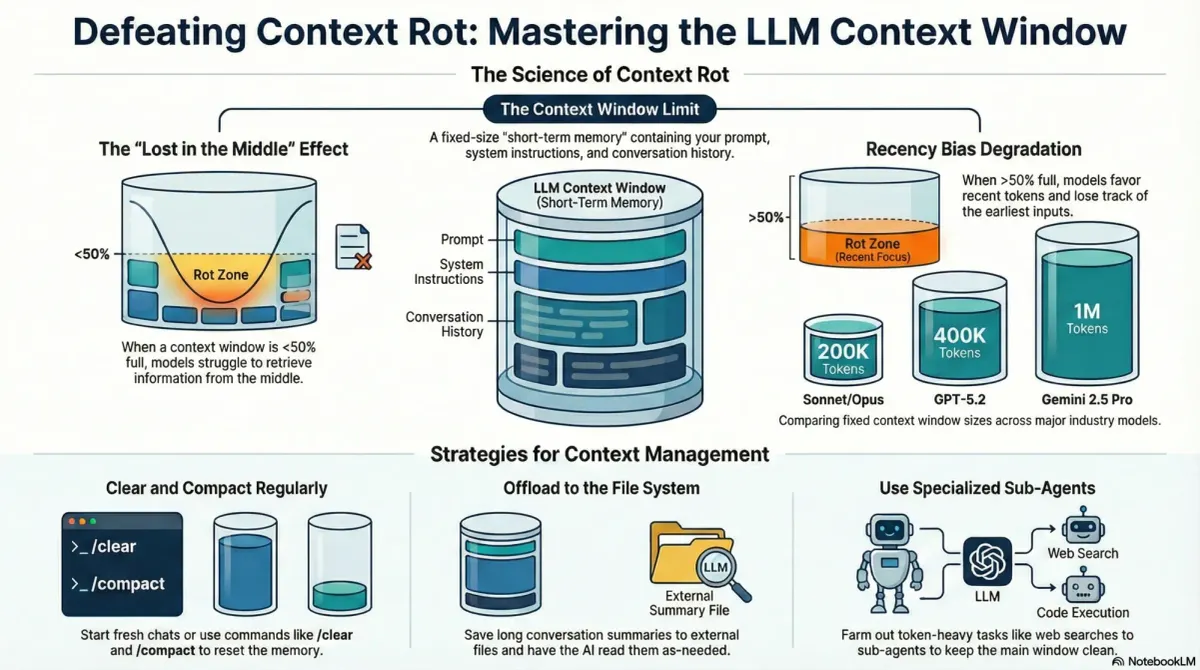
Roleplay is a worst-case version of that problem. The important fact is rarely the last line. It is a name from scene four, a lie from last Tuesday, a juice box that hit the pavement and changed how someone looks at you. Models already use the middle of a long prompt less reliably than the ends. Chroma also found that logically structured “haystacks” hurt more than shuffled ones — which is exactly what a well-written scene is.
A published sixty-turn roleplay test makes the player-facing cost obvious.
1 of 5 facts — Recall by turn 40 when only recent conversation is kept
The failing run did not say “I forget.” It invented a guildmaster, a town, and an oath that had never existed. Blank amnesia is annoying. Confident false canon is how a long story dies.
Stuffing the window does not close the gap. On LoCoMo long-conversation questions, a full-history prompt used about 26,031 tokens per answer. A structured memory layer reached 81.95% accuracy with 1,294 tokens — roughly 5% of the full-context footprint. The extra tens of thousands of tokens were mostly noise the model then had to ignore.
By default the model is also stateless: each call only knows what you feed it. Long-term memory has to be designed as an external system, not assumed because the brochure says 1M.
But getting roleplay that feels remembered, not improvised-and-forgotten, is frustratingly difficult:
- Mid-story facts vanish even when the advertised window is huge
- Character voice, inventory, and motives drift after a few thousand tokens
- You become the unpaid archivist, pasting recaps every session
- Filling the 1M window can make the scene worse, not richer
This is exactly what Roleplay Game Master was built for.
Why Roleplay Game Master Holds the Story
This 1M context roleplay AI does not treat a million tokens as a dumpster for every past message. It runs the live scene in a large working context, then keeps the world alive as state — who you are, what the other person believes, which promises are unpaid, and which rooms still have blood on the floor.
That is the difference between volatile RAM and a director’s notebook. Serious roleplay products already show why the notebook matters: location, time, relationship scores, and tone sitting beside the chat, not buried in paragraph 400.
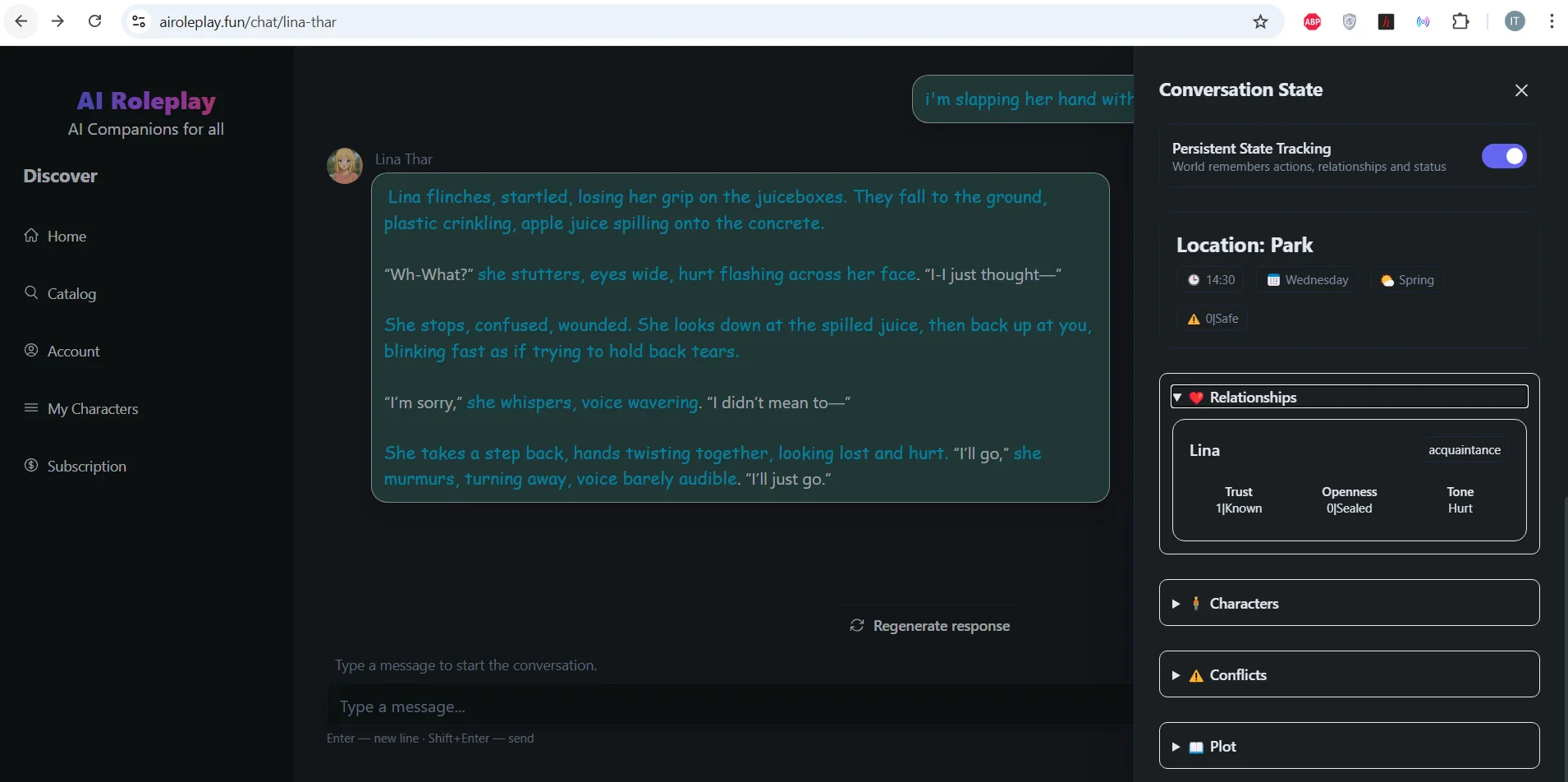
A sidebar that still knows you are in a park at 14:30, that trust is thin, and that the last beat was hurt — not a vibe the model has to re-infer from a novel-length log — is the architecture a 1M window cannot replace. NPC long-term memory research makes the same split: episodic events, semantic facts, and the procedures of how a character acts.
| Traditional 1M Chat | Roleplay Game Master |
|---|---|
| Paste the whole transcript into a million-token window | Scene context plus stored world state |
| NPCs reset personality as recency bias takes over | Stable voice, motives, and unfinished business |
| You maintain a separate wiki of names and maps | World knowledge recalled when it matters |
/clear or /compact to fight context rot | Continuity without wiping the relationship |
| New chat = new universe | Cross-session continuity without a lore dump |
What that means in play
Character continuity. Someone who watched you drop the juice boxes should still be shaken next week. Relationships are facts, not vibes that evaporate when the window rolls.
World state, not atmosphere. Location, time of day, inventory, and clocks keep moving. If you burned the east dock, the next scene does not pretend the dock is fine.
Play the way you actually play. Sandbox, mystery, romance, horror, or a one-shot that grew into a campaign — you set tone and boundaries; the partner follows them.
You stop doing continuity homework. Recaps, name lists, and “remember my scar” prompts become optional, not mandatory.
Workarounds that help coding agents — compact the thread, offload summaries to a file, farm token-heavy chores to sub-agents — are a poor fit for roleplay. You should not /clear a confession. You should not hope a summary file still contains the exact wording of a promise. The story needs the fact available at the moment it collides with the present scene.
Example openings you can actually type:
"Slow-burn slice of life in a canal city. I am a night clerk who forged a census. Track every bribe, every NPC lie, and never reset how she looks at me after the park."
"Continue from last session. Lina still thinks I slapped the juice out of her hands on purpose. Trust is wrecked. Do not retcon the spill."
"One-shot heist tonight, then save the crew. If we survive, next session is the fallout, not a new story."
Related Agents You'll Also Find Useful
If you want a authored hook instead of a blank sandbox, these games sit next to a custom campaign.
Love Island
If you also want open-world romance with emergent social dynamics rather than a fully improvised setting, Love Island drops you among eight strangers on a private island. Connections and rejections compound; memory of who you snubbed is the whole game.
- Relationship fallout as the engine, not a side plot
- Character-driven scenes where every evening rewrites the board
- A contained cast that still needs long-range recall of who you trusted
The Mansion
If you prefer locked-room dread, The Mansion wakes you in a house that does not explain itself. Every room is a clue or a trap.
- Exploration-first play with secrets behind ordinary doors
- High tension without requiring you to invent the entire setting
- Escape and revelation as the story spine
The Asylum
If investigation is the fantasy, The Asylum casts you as an investigator sent into a shuttered institution — except the assignment already went wrong.
- Ward-by-ward secrets and unreliable spaces
- Mystery structure with room for improvisation
- A story that punishes forgotten details, which is why memory matters
K-Pop Producer
If you want a timed production drama instead of freeform chat, K-Pop Producer puts you in charge of debuting a group across 60 intense days. Trainee politics only work if yesterday’s slight is still on the board.
- Power dynamics that accumulate instead of resetting
- Career choices with delayed consequences
- A finite season that still needs character consistency night after night
Try Roleplay Game Master free — no credit card required.
How to Start a 1M Context Roleplay AI Session
Step 1: Establish the World and Who You Are State genre, tone, and your character in specifics. Adjectives are weaker than facts. “Tired paladin” is thinner than “disgraced temple accountant who still wears the ring.”
"Grounded modern drama, no joke NPCs. I am Ila Sen, a river-pilot whose charts were stolen. Sandbox play in the port of Kess. She already distrusts me from the park."
Step 2: Tell the Partner What Must Never Drift Call out continuity rules up front: names, injuries, magic costs, fade-to-black, or a hard ban on retconning deaths. This becomes procedural memory for the story.
"Never forget NPC names. Injuries persist. If I make a deal, the other party remembers the exact terms. Do not fast-forward past consequences."
Step 3: Play the Beat, Then Push the World Make a concrete move. Ask what you see, who notices, and what it costs. The AI game master should answer with observable detail, not a summary of your feelings.
"I wait until she is alone and set the unbroken juice box on the bench. What does she do with her hands?"
Step 4: Leave and Come Back Without a Lore Dump End on a hook. Next session, give a short “when we last left” only if you want to steer. Persistent memory should already know the bench, the spill, and the unfinished hurt.
"Same story. Ila still has the forged berth token. Open on the dock before dawn."
Step 5: Branch, Recap, or Change the Rules Mid-Story You can request a recap, freeze a timeline, or switch from sandbox to mystery. Say so in plain language; do not restart the chat to “fix” tone.
"Give me a three-bullet recap of unpaid debts, then skip two weeks. The city is under quarantine."
Results & Use Cases
📊 Multi-Session Character Arc That Still Has a Map
Scenario: You want a port-city story that lasts weeks, with gangs, tides, and three rival captains who all think you work for them — plus one civilian who has not forgiven the park.
Traditional Approach: You keep a notes app, paste a 2,000-word recap every night, and still watch NPCs forget the dock fire. A raw 1M paste helps until the middle of the prompt goes quiet and context rot sets in.
This 1M context roleplay AI: The city remains the same city. Captains keep their lies. Your inventory and reputation travel with you.
- Factions remember slights without a wiki
- Geography stays stable enough to plan heists
- You spend sessions playing, not briefing
💼 Mystery Where Clues Cannot Teleport
Scenario: A locked-house mystery in the style of The Mansion: you need the bloody glove in the study to still be in the study.
Traditional Approach: The model invents a second glove, relocates the body, or “helpfully” solves the case because the clue list fell out of the window.
Roleplay Game Master: Clues are state. If you hid a letter, later scenes can search the same hiding place.
- Fair-play investigation instead of shapeshifting rooms
- NPCs who stick to earlier testimony unless they are lying on purpose
- Recaps that match the evidence you actually found
📱 Commute-Length Scenes on a Phone
Scenario: You have twelve minutes on a train. You want one sharp scene — a negotiation, a chase, a quiet apology — then the ability to lock the phone and resume the same relationship that night.
Traditional Approach: Mobile chats truncate history, lose formatting, or greet you like a new player. You spend the next session re-teaching your character’s name.
This AI: Full play on iOS and Android with the same story memory as desktop. Short scenes still write into long-term state.
- Pick up mid-dialogue without a recap ritual
- Voice-to-text for walking scenes, then switch back to typing for combat
- Continuity that survives app switches
🎯 Horror That Punishes Forgotten Details
Scenario: An institution crawls with ward-specific rules, like The Asylum. A key you took in Ward B must open — or fail — in Ward D for reasons the story already established.
Traditional Approach: The AI improvises a new myth every message because it cannot hold the first one. Million-token chats delay that failure; they do not prevent it.
Roleplay Game Master: The mythology stays expensive. You feel the cost of earlier choices because the referee still has them.
- Dread from consistency, not from random shocks
- Rituals and house rules that do not rewrite themselves
- A campaign you can discuss with friends without contradicting last week
FAQ
What is a 1M context roleplay AI?
A 1M context roleplay AI is a roleplaying system whose model can take on the order of one million tokens in one pass — prompt, history, and the next scene together. That window is the working set, not a guarantee of recall. Official model docs now warn that accuracy degrades as token count grows. Persistent world memory is what turns a large window into a story that lasts.
Is Roleplay Game Master free?
Yes. You can run stories on the free tier with all core play features and limited usage. Paid tiers raise monthly usage if you play long daily sessions. There is no credit card required to start, and usage resets on your billing date rather than as a daily drip.
How is a 1M context window different from persistent memory?
Context is RAM: whatever still fits in the current prompt. Persistent memory is the save file: episodic events, semantic lore, and procedural rules that can be retrieved later. Language-model agents cannot update their weights mid-play, so continuity has to live in a memory system. A 1M context roleplay AI that only streams chat history will still forget; one that stores the world will not.
Can Roleplay Game Master remember characters across sessions?
That is the point of the design. Names, bargains, injuries, and standing are treated as story state, not as text that must be re-pasted. You can still give a short steering recap if you want to highlight a thread, but you should not need a novel-length briefing to keep a bartender’s lie intact. Structured memory tests on long conversations show that compact facts beat dumping the full log.
Does a 1M context roleplay AI work on mobile?
Yes. Play on the web, iPhone, or Android with the same story. Settings and history sync, so a scene started on a laptop can continue on a phone without creating a second universe. Speech-to-text is available when you want hands-free dialogue.
Why not just paste the whole campaign into a 1M window?
Benchmarks keep showing that fitting text into the window is not the same as using it. Extra tokens add a retrieval job on top of the writing job, and quality falls even when the needed sentence is still present. Roleplay Game Master keeps the live scene lean and retrieves what the current move needs, instead of asking attention to search a novel for a single inventory line.
Conclusion
A 1M context roleplay AI sounds like it should already be a great scene partner. The research says otherwise: large windows still rot, lose the middle, and treat every session as a blank page unless something stores the world. Roleplay Game Master is the story you actually wanted from that search — long-context play plus memory that keeps characters, maps, and consequences aligned.
If you have been pasting recaps into a million-token chat and watching NPCs still forget your name, stop briefing the model and start playing. Try Roleplay Game Master now, then explore more at Jenova.
For Developers: Roleplay Game Master is available programmatically via the Jenova API — integrate persistent, long-context AI roleplay into your application with a single API call. Full documentation →