128K Context AI RPG: Persistent Memory for Epic Campaigns
2026-09-15
Roleplay Game Master helps you run long, choice-driven campaigns by pairing a large working context with memory that actually keeps NPCs, loot, and plot promises straight. While a raw 128K context AI RPG window can hold hundreds of pages in one pass, most chat tools still drop mid-story facts, flatten character voice, and force you to paste recaps. This AI treats your world as a living campaign, not a disposable transcript.
✅ Persistent recall of characters, factions, and unresolved hooks ✅ Consistent NPC voice, inventory, and consequences across sessions ✅ Sandbox or linear play with full creative freedom ✅ Playable on web, iPhone, and Android without losing campaign state
In September 2026, players searching for a 128K context AI RPG are usually chasing one outcome: a game that still knows who betrayed whom three sessions ago. To understand why a bigger token window is not enough on its own, it helps to look at how context, attention, and memory actually behave in long-form roleplay.
Quick Answer: What Is a 128K Context AI RPG?
Roleplay Game Master is a 128K context AI RPG that runs immersive campaigns with persistent memory so characters, lore, and plot stay consistent across every session. It is built for players who want tabletop-depth continuity without a human GM taking notes.
Key capabilities:
- Long-session play that retains names, maps, debts, and secrets
- Character-consistent NPCs who remember your bargains and insults
- Open-ended scenarios — horror, romance, heist, high fantasy, or original settings
- Cross-session continuity so you can close the app and resume the same world
A 128K context window is the amount of text a model can consider at once, including the system prompt, your messages, and the running scene. That capacity is useful. It is not the same thing as a campaign that remembers.
Why 128K Context Alone Fails in AI Roleplay
A context window is working memory, not a campaign bible. Guides describe it as the maximum text a model can “see” in a single pass — history, instructions, and the latest move together — so anything shoved out of that window is gone unless some other system stored it (LLM Configurator).
On paper, 128K tokens is a lot of story.
250–380 pages — Approximate text that fits in a 128K token window
That sounds like enough for a novel-length dungeon. In practice, stuffing a window is not the same as using it. Stanford researchers showed that models often answer well when the needed fact sits at the start or end of a long prompt, and stumble when the same fact is buried in the middle — the now-standard “lost in the middle” pattern.
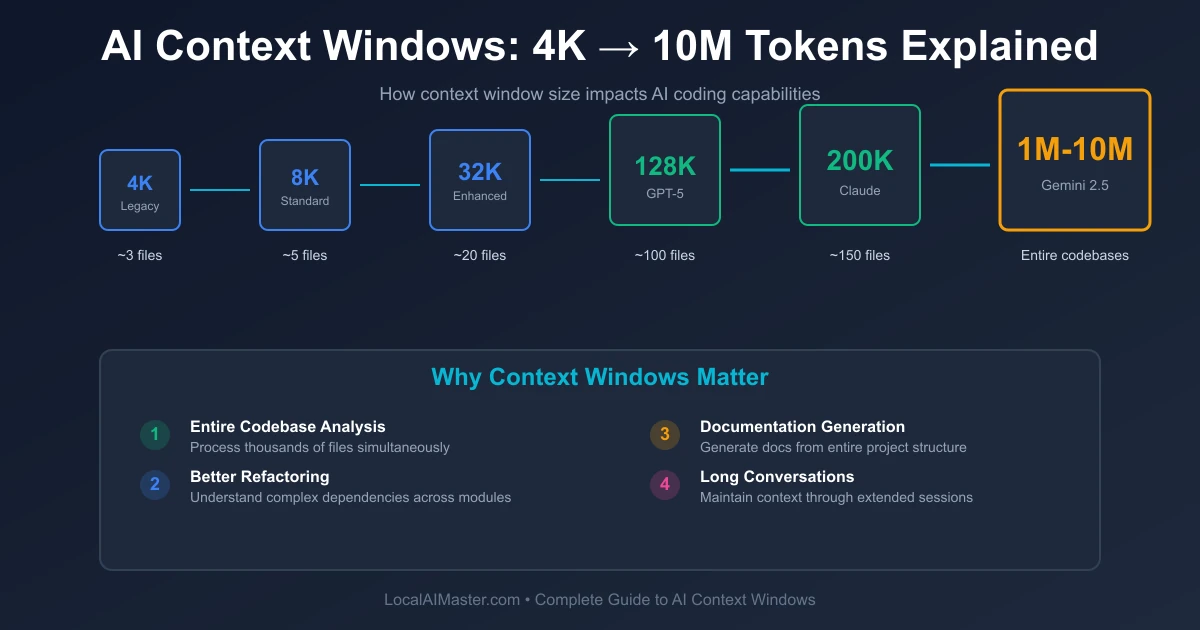
The ACL LooGLE benchmark reached a sharper conclusion: many models still fail to capture long-range dependencies even when the full document fits. Databricks’ long-context tests found the same curve in applied systems — more tokens can help up to a point, then quality drops. In their runs, Llama 3.1 405B weakened after 32K tokens and a GPT-4 snapshot declined after 64K.
By default, the model is also stateless: each call only knows what you feed it. No hidden save file exists unless the product builds one.
But getting a campaign that feels refereed, not improvised-and-forgotten, is frustratingly difficult:
- Mid-campaign facts vanish even when the advertised window is huge
- NPC voice, inventory, and motives drift after a few thousand tokens
- You become the unpaid archivist, pasting recaps every session
- Filling the window can make the scene worse, not richer
This is exactly what Roleplay Game Master was built for.
Why Roleplay Game Master Works for Long Campaigns
This AI RPG does not treat 128K tokens as a dumpster for every past message. It runs the scene in a large working context, then keeps the campaign alive in structured memory — who you are, what the world believes, which skills fired, and which promises are still unpaid.
That is the difference between volatile RAM and a referee’s notebook.
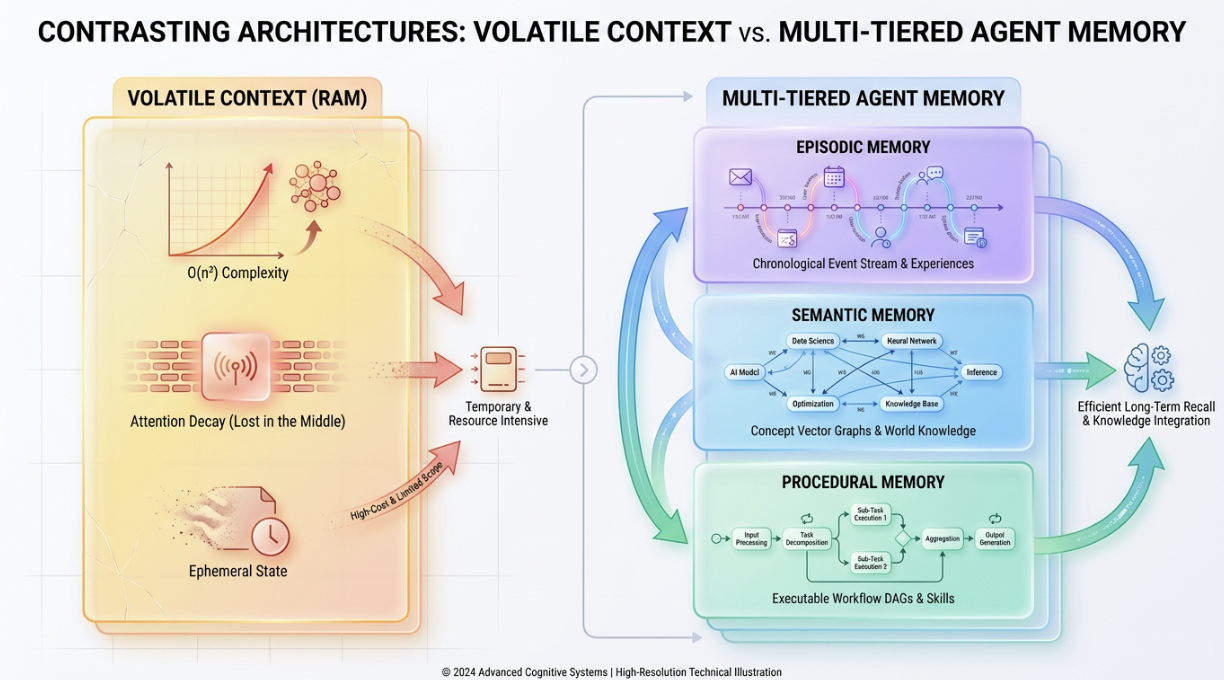
The left side of that architecture is what most “just use 128K” chats actually ship: quadratic attention cost, attention that fades in the middle of the prompt, and an ephemeral state that dies when the window rolls. The right side is what a serious 128K context AI RPG needs: episodic memory for the event stream, semantic memory for lore and relationships, and procedural memory for how the game is played.
| Traditional Approach | Roleplay Game Master |
|---|---|
| Paste a 128K transcript and hope the model rereads it | Scene context plus stored campaign state |
| NPCs reset personality when the window fills | Stable voice, motives, and unfinished business |
| You maintain a separate wiki of names and maps | World knowledge recalled when it matters |
| House rules forgotten mid-combat | Procedural play that keeps resolution consistent |
| New chat = new universe | Cross-session continuity without a lore dump |
What that means at the table
Character continuity. A smuggler who saw you hide the reliquary should still be dangerous next week. The game master tracks relationships as facts, not as vibes that evaporate.
World state, not vibes. Factions, locations, and clocks keep moving. If you burned the east dock, the next scene does not pretend the dock is fine.
Play the way you actually play. Sandbox, mystery, romance, horror, or a one-shot that grew into a campaign — you set tone and boundaries; the referee follows them.
You stop doing GM homework. Recaps, name lists, and “remember my scar” prompts become optional, not mandatory.
Example openings you can actually type:
"Run a slow-burn political campaign in a canal city. I am a clerk who forged a census. Track every bribe, every NPC lie, and never reset the city map."
"Continue from last session. Captain Vey still owes me a berth, my coat is still bloodstained, and the cult’s password is still wrong."
"One-shot heist tonight, then save the crew. If we survive, next session is the fallout, not a new story."
Related Agents You'll Also Find Useful
If you want a authored story with a fixed hook instead of a blank sandbox, these games sit next to a custom campaign.
Vesper Court
If you also want dark romance with court intrigue rather than a fully improvised setting, Vesper Court drops you into a hidden vampire household with no memory of why you belong there. Nights compound; alliances curdle.
- Blood politics and forbidden desire as the engine, not a side plot
- Character-driven scenes where every evening rewrites the board
- A contained world that still needs long-range memory of who you trusted
The Mansion
If you prefer locked-room dread, The Mansion wakes you in a house that does not explain itself. Every room is a clue or a trap.
- Exploration-first play with secrets behind ordinary doors
- High tension without requiring you to invent the entire setting
- Escape and revelation as the campaign spine
The Asylum
If investigation is the fantasy, The Asylum casts you as an investigator sent into a shuttered institution — except the assignment already went wrong.
- Ward-by-ward secrets and unreliable spaces
- Mystery structure with room for improvisation
- A story that punishes forgotten details, which is why memory matters
Game Designer Assistant
If you are building the system under the fiction — clocks, classes, factions, or a homebrew setting bible — Game Designer Assistant is the workshop next to the table.
- Systems analysis and documentation for original RPGs
- Genre, platform, and market-aware brainstorming
- A place to stress-test rules before you play them
Try Roleplay Game Master free — no credit card required.
How to Start a 128K Context AI RPG Campaign
Step 1: Establish the World and Your Character State genre, tone, and who you are playing. Specifics beat adjectives. A “tired paladin” is weaker than a “disgraced temple accountant who still wears the ring.”
"Dark fantasy, grounded and grim, no joke NPCs. I am Ila Sen, a river-pilot whose charts were stolen by the harbormaster. I want sandbox play in the port of Kess."
Step 2: Tell the Referee What Must Never Drift Call out continuity rules up front: names, injuries, magic costs, romance fade-to-black, or a hard ban on retconning deaths. This becomes procedural memory for the campaign.
"Never forget NPC names. Injuries persist. If I make a deal, the other party remembers the exact terms. Do not fast-forward past consequences."
Step 3: Play the Scene, Then Push the World Make a concrete move. Ask what you see, who notices, and what it costs. The AI game master should answer with observable detail, not a summary of your feelings.
"I wait until the night clerk is alone and slide the forged berth token across the desk. What does he do with his hands?"
Step 4: Leave and Come Back Without a Lore Dump End on a hook. Next session, give a short “when we last left” only if you want to steer. Persistent memory should already know the clerk, the token, and the unfinished threat.
"Same campaign. Ila still has the token. Open on the dock before dawn."
Step 5: Branch, Recap, or Change the Rules Mid-Campaign You can request a recap, freeze a timeline, or switch from sandbox to mystery. Say so in plain language; do not restart the chat to “fix” tone.
"Give me a three-bullet recap of unpaid debts, then skip two weeks. The city is under quarantine."
Results & Use Cases
📊 Multi-Session Sandbox That Still Has a Map
Scenario: You want a port-city campaign that lasts weeks, with gangs, tides, and three rival captains who all think you work for them.
Traditional Approach: You keep a notes app, paste a 2,000-word recap every night, and still watch NPCs forget the dock fire. A raw 128K paste helps until the middle of the prompt goes quiet.
Roleplay Game Master: The city remains the same city. Captains keep their lies. Your inventory and reputation travel with you.
- Factions remember slights without a wiki
- Geography stays stable enough to plan heists
- You spend sessions playing, not briefing
💼 Mystery Where Clues Cannot Teleport
Scenario: A locked-house mystery in the style of The Mansion: you need the bloody glove in the study to still be in the study.
Traditional Approach: The model invents a second glove, relocates the body, or “helpfully” solves the case because the clue list fell out of the window.
Roleplay Game Master: Clues are state. If you hid a letter, later scenes can search the same hiding place.
- Fair-play investigation instead of shapeshifting rooms
- NPCs who stick to earlier testimony unless they are lying on purpose
- Recaps that match the evidence you actually found
📱 Commute-Length Scenes on a Phone
Scenario: You have twelve minutes on a train. You want one sharp scene — a negotiation, a chase, a quiet conversation — then the ability to lock the phone and resume at the same table that night.
Traditional Approach: Mobile chats truncate history, lose formatting, or greet you like a new player. You spend the next session re-teaching your character’s name.
This 128K context AI RPG: Full play on iOS and Android with the same campaign memory as desktop. Short scenes still write into long-term state.
- Pick up mid-dialogue without a recap ritual
- Voice-to-text for walking scenes, then switch back to typing for combat
- Continuity that survives app switches
🎯 Horror That Punishes Forgotten Details
Scenario: An institution crawls with ward-specific rules, like The Asylum. A key you took in Ward B must open — or fail — in Ward D for reasons the story already established.
Traditional Approach: The AI improvises a new myth every message because it cannot hold the first one.
Roleplay Game Master: The mythology stays expensive. You feel the cost of earlier choices because the referee still has them.
- Dread from consistency, not from random shocks
- Rituals and house rules that do not rewrite themselves
- A campaign you can discuss with friends without contradicting last week
FAQ
What is a 128K context AI RPG?
A 128K context AI RPG is a roleplaying game whose model can take on the order of 128,000 tokens in one pass — typically hundreds of pages of combined prompt, history, and scene. That window is the working set, not a guarantee of recall. Products that only enlarge the window still miss facts in the middle of long inputs. Persistent campaign memory is what turns a large window into a campaign that lasts.
Is Roleplay Game Master free?
Yes. You can run campaigns on the free tier with all core play features and limited usage. Paid tiers raise monthly usage if you play long daily sessions. There is no credit card required to start, and usage resets on your billing date rather than as a daily drip.
How is a 128K context window different from persistent memory?
Context is RAM: whatever still fits in the current prompt. Persistent memory is the save file: episodic events, semantic lore, and procedural rules that can be retrieved later. Language models are stateless unless a product stores state for them. A 128K context AI RPG that only streams chat history will still forget; one that stores the world will not.
Can Roleplay Game Master remember NPCs across sessions?
That is the point of the design. Names, bargains, injuries, and faction standing are treated as campaign state, not as text that must be re-pasted. You can still give a short steering recap if you want to highlight a thread, but you should not need a novel-length briefing to keep a bartender’s lie intact.
Does a 128K context AI RPG work on mobile?
Yes. Play on the web, iPhone, or Android with the same campaign. Settings and history sync, so a scene started on a laptop can continue on a phone without creating a second universe. Speech-to-text is available when you want hands-free dialogue.
How is this different from stuffing the whole campaign into the prompt?
Benchmarks keep showing that fitting text into the window is not the same as using it. Extra tokens can even hurt after a saturation point (Databricks). Roleplay Game Master keeps the live scene lean and retrieves what the current move needs, instead of asking attention to search a novel for a single inventory line.
Conclusion
A 128K context AI RPG sounds like it should already be a great game master. The research says otherwise: large windows still lose the middle, go stale, and treat every session as a blank page unless something stores the world. Roleplay Game Master is the campaign you actually wanted from that search — long-context play plus memory that keeps characters, maps, and consequences aligned.
If you have been pasting recaps into a 128K chat and watching NPCs still forget your name, stop briefing the model and start playing. Try Roleplay Game Master now, then explore more at Jenova.
For Developers: Roleplay Game Master is available programmatically via the Jenova API — integrate persistent, long-context AI RPG sessions into your application with a single API call. Full documentation →